Willibrord is a saint of the Catholic Church (658 - 739). Willibrord's feast day is celebrated on 7 November. Willibrord is the patron saint of Luxembourg;the Netherlands;Utrecht;Echternach;epilepsy;convulsions.
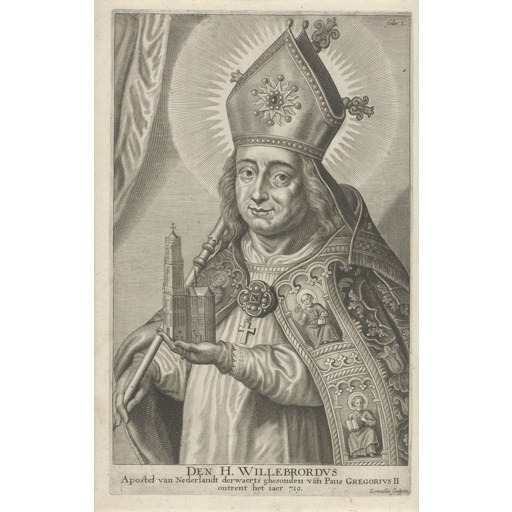
Rijksmuseum
License: CC0
Willibrord
Saint- Life Span
- 658 - 739 (age 81)
- Feast Day
- 7 November
- Gender
- male
- Church
- Catholic
Places
Relics & Where to Venerate
Location unknown
The bodily remains of Willibrord are a first-class relic. Venerated at St. Willibrord Basilika.
Roles & Family
Religious Information
Patronage
Luxembourg;the Netherlands;Utrecht;Echternach;epilepsy;convulsions
Biography
Willibrord was born about 658 in the Anglo-Saxon kingdom of Northumbria. His father, Wilgils, later withdrew from secular life to live as a hermit near the Humber, where he established a small monastic cell. As a boy Willibrord was given to the monastery of Ripon, then under Saint Wilfrid, and there he was formed in the monastic life according to the Benedictine observance that Wilfrid had introduced. Around the age of twenty he left Northumbria for Ireland and joined the Anglo-Saxon community at Rath Melsigi in what is now County Carlow. He remained in Ireland for some twelve years under the Northumbrian exile Egbert, who had long hoped to send a mission to the still-pagan Frisians.
In 690, with Egbert’s encouragement and at the head of twelve companions, Willibrord crossed to the Continent. Pepin of Herstal, mayor of the palace of Austrasia, had recently extended Frankish power over western Frisia and was willing to protect a Christian mission there. Willibrord made Utrecht his centre. In 692 he went to Rome to obtain the approval of Pope Sergius I; he returned in 695 and was consecrated by the same pope as archbishop of the Frisians, receiving the name Clement. Pepin granted him the fortress of Utrecht as an episcopal see. From that base he organized churches, ordained clergy, and sought to replace pagan cult sites with Christian worship.
In 698 Irmina, abbess of Oeren near Trier, together with her daughter Plectrude, wife of Pepin, granted Willibrord the estate of Echternach on the river Sauer. There he founded a monastery that served as a missionary base, a place of retreat, and in time his burial church. The work in Frisia was interrupted when the Frisian king Radbod recovered territory after Pepin’s death in 714 and expelled Christian clergy; Willibrord withdrew for a period to Echternach. After Radbod’s death in 719, Charles Martel restored Frankish authority and Willibrord resumed the mission, assisted for a time by the younger Anglo-Saxon Boniface before the latter moved on to the German lands. Willibrord also made at least one journey farther north into Danish territory and is associated with missionary efforts in Thuringia, though the lasting fruit of his labour remained in Frisia and the Moselle region.
Willibrord died on 7 November 739 at Echternach, in his eighty-first year, and was buried in the oratory of the monastery he had founded. His tomb soon became a place of pilgrimage. Alcuin of York, a kinsman, composed both a prose and a verse life of the saint toward the end of the eighth century, drawing on Echternach tradition. The cult spread through the Frankish world and later throughout the Low Countries. At Echternach a distinctive hopping or dancing procession in his honour is attested from the later Middle Ages and is still held. Willibrord is venerated as the apostle of the Frisians and as a principal patron of the Netherlands and of Luxembourg.