Wincenty Kadłubek is a saint of the Catholic Church (d. 1223). Wincenty Kadłubek's feast day is celebrated on 8 March. Wincenty Kadłubek is the patron saint of Diocese of Kielce;Jędrzejów.
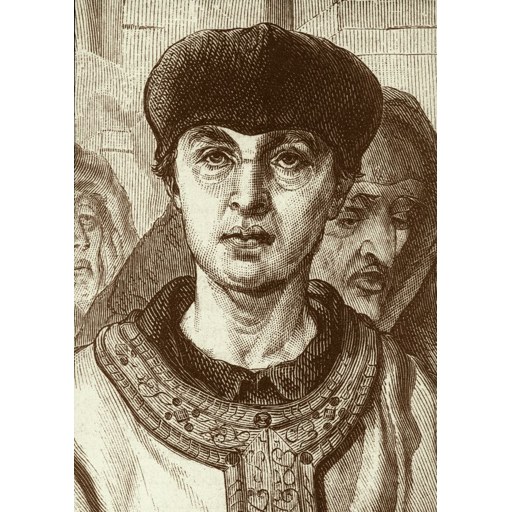
Julian Schübeler / Jan Matejko
License: Public domain
Wincenty Kadłubek
Saint- Life Span
- d. 1223
- Feast Day
- 8 March
- Gender
- male
- Church
- Catholic
Places
Relics & Where to Venerate
Location unknown
The bodily remains of Wincenty Kadłubek are a first-class relic. Venerated at Jędrzejów Abbey.
Roles & Family
Religious Information
Patronage
Diocese of Kielce;Jędrzejów
Canonization
Biography
Wincenty Kadłubek, also known in Latin as Vincentius and in later devotion as Blessed Wincenty Kadłubek, was a Polish chronicler, bishop of Kraków, and Cistercian monk, and one of the principal learned figures of Piast Poland in the late twelfth and early thirteenth centuries. He was born in the mid-twelfth century, according to a long-standing tradition in the village of Karwów near Stopnica in the Sandomierz land of Lesser Poland, into a family of the regional nobility; the exact year of his birth is not recorded in contemporary sources, and modern estimates placing it around the 1150s or about 1160 remain conjectural. Little that is strictly documentary survives about his parents or lineage, though later writers associated him with knightly houses of that district. He received an education far beyond what was then usual in Poland, studying in Western schools—Paris is the center most often named, and Bologna is also frequently suggested—where he acquired Roman and canon law, theology, and the rhetorical Latin of the schools. The academic title Magister, by which he was later known in Poland (Mistrz Wincenty), reflects that university formation.
After returning to Poland he entered the service of the Church and of the Kraków court. He is attested as a canon and subsequently as provost of the collegiate church of Sandomierz, and he served as chaplain and notary to Duke Casimir II the Just. In 1208 he was elected bishop of Kraków, then one of the foremost sees of the Polish Church. As bishop he aligned himself with the reform program of Pope Innocent III: he sought to defend ecclesiastical liberties and church courts against ducal pressure, to raise clerical discipline, and to favor the endowment of religious houses. He took part in the Fourth Lateran Council in 1215. In 1218 he resigned the bishopric, an uncommon decision for a prelate of his rank, and withdrew to the Cistercian abbey of Jędrzejów in his former diocese, where he took the Cistercian habit and lived as a monk. He died at Jędrzejów on 8 March 1223 and was buried in the abbey; his remains were later translated within the monastic church and became the focus of a local cult.
Kadłubek’s enduring historical importance rests on his Chronica Polonorum (Chronicle of the Poles), a Latin history in four books, composed in the early thirteenth century, whether during his episcopate or in monastic retirement remains a matter of scholarly discussion. The work surveys Polish history from legendary origins through the reign of Bolesław III Wrymouth and down to events of the first years of the thirteenth century, closing around 1202. It is not an annalistic compilation but a highly literary composition, dense with classical and biblical allusion, invented speeches, and moral-political argument. Kadłubek presented the Poles as a people with ancient roots and a distinctive political culture, and he offered a learned justification of Piast ducal authority and of the community of the realm. The first books, which treat pre-Christian and early legendary material, are treated by modern historians as literary and ideological constructions rather than as reliable narrative; the later books, closer to his own lifetime and to court memory, are valued as a major narrative source for twelfth-century Poland. The chronicle circulated widely in manuscript, shaped subsequent Polish historiography, and was first printed in the early seventeenth century.
A cult of Wincenty developed at Jędrzejów in the centuries after his death. In the eighteenth century the Holy See examined that cult; Pope Clement XIII confirmed it on 18 February 1764, an act treated in Catholic practice as beatification. He was not subsequently canonized and is commemorated as Blessed, with his feast on 8 March, the anniversary of his death. In Polish Catholic usage he is invoked as a patron of the Diocese of Kielce, whose territory includes both his traditional birthplace and Jędrzejów, and of the town of Jędrzejów itself. His relics remain associated with the former Cistercian church there. As bishop, monk, and author of the Chronica Polonorum he stands at the meeting point of Gregorian church reform, Cistercian monasticism, and the beginnings of a self-consciously literary Polish historiography.