Wulfhild is a saint of the Catholic Church. Wulfhild's feast day is celebrated on 9 September.
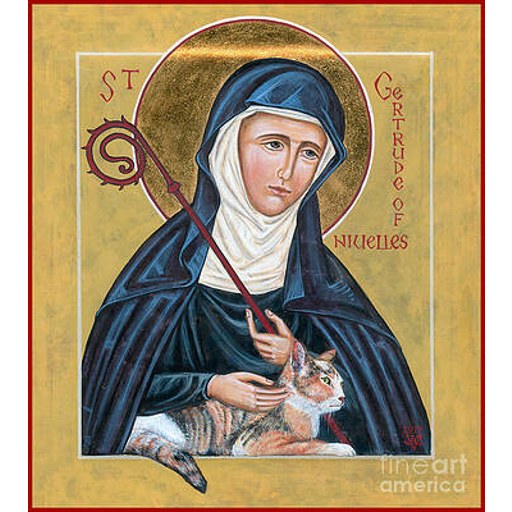
https://fineartamerica.com/art/paintings/saint+gertrude
License: unknown
Wulfhild
Saint- Feast Day
- 9 September
- Gender
- female
- Church
- Catholic
Places
Relics & Where to Venerate
Location unknown
The bodily remains of Wulfhild are a first-class relic. Venerated at Barking Abbey.
Roles & Family
Religious Information
Biography
Wulfhilda of Barking, whose name is also given as Wulfhild or Wulfilda, was a tenth-century Anglo-Saxon noblewoman and Benedictine abbess. She was the daughter of a nobleman named Wulfhelm. Almost nothing is recorded of her early years beyond the fact that she was educated at Wilton Abbey in Wiltshire, a leading house of nuns and a school for daughters of the English aristocracy. There she received the religious and literary formation typical of elite female monasticism in late Anglo-Saxon England, and from youth she intended to remain in the cloister rather than enter a secular marriage.
The principal account of her life is the Latin vita written in the later eleventh century by Goscelin of Saint-Bertin, a Flemish monk working in England after the Norman Conquest, who composed saints' lives for several English communities including Barking. According to Goscelin, King Edgar (reigned 959–975) sought Wulfhilda as a wife or companion. She refused him, having already chosen the monastic life. Later tradition added a dramatic escape in which she slipped away through the abbey drains to avoid the king. Edgar did not punish her for the refusal. He instead appointed her abbess of Barking Abbey in Essex, an ancient and wealthy nunnery founded in the seventh century, and also placed the abbey of Horton in Kent under her care, so that she ruled two Benedictine communities.
Her authority at Barking was later broken by Queen Ælfthryth, Edgar's widow and mother of King Æthelred. Goscelin presents the queen as hostile to Wulfhilda, whether from jealousy or from a dispute over the abbey's position and estates. Ælfthryth succeeded in expelling her from Barking. Wulfhilda withdrew to Horton and remained there for some twenty years. After Ælfthryth's death, King Æthelred restored her to Barking. She resumed the government of the house and continued as abbess until her death, which later tradition places around the year 1000. No contemporary charter or chronicle supplies an independent narrative of these events, and the exact years of her birth and death are unknown.
After her death the community of Barking honoured her as a saint. Her feast is kept on 9 September. Goscelin's vita, written at the nuns' request, mixes recollection with the conventional motifs of hagiography and remains the essential source. She was never the subject of a formal papal canonization; her cult belongs to the age of local and popular recognition. She is commemorated in the Roman Catholic and Eastern Orthodox traditions as a virgin abbess. No widespread patronages are attached to her name beyond the memory of her own community. She was in all probability buried at Barking Abbey, the house she had ruled.