Wulfstan is a saint of the Catholic Church (d. 1095). Wulfstan's feast day is celebrated on 19 January. Wulfstan is the patron saint of Worcester.
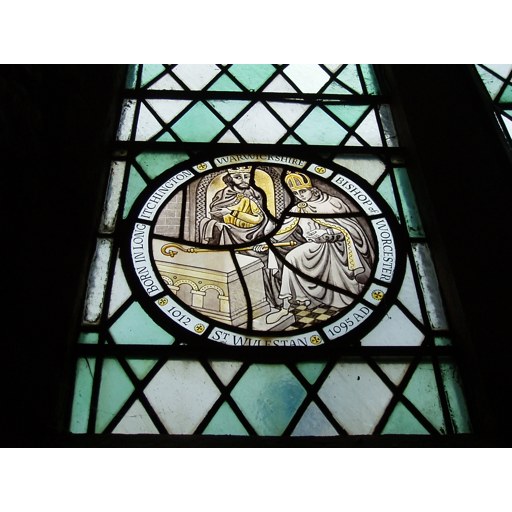
Amanda Slater from Coventry, West Midlands, UK
License: CC BY-SA 2.0
Wulfstan
Saint- Life Span
- d. 1095
- Feast Day
- 19 January
- Gender
- male
- Church
- Catholic
Places
Relics & Where to Venerate
Location unknown
The bodily remains of Wulfstan are a first-class relic. Venerated at Worcester Cathedral.
Roles & Family
Religious Information
Patronage
Worcester
Canonization
Biography
Wulfstan, commonly called Wulfstan of Worcester to distinguish him from the earlier archbishop and homilist of the same name, was an English Benedictine monk and bishop of the eleventh century. He was born at Long Itchington in Warwickshire to parents named Æthelstan and Wulfgifu, people of respectable but not exalted standing who themselves later entered religion. Medieval biographers, drawing on a lost English life by his chaplain Coleman as recast in Latin by William of Malmesbury, place his birth about the beginning of the century and describe a youth formed by the monastic schools of Evesham and Peterborough. After ordination to the priesthood he served for a time at Hawkesbury in Gloucestershire. Finding the life of a secular clerk a hindrance to the austerity he sought, he entered the Benedictine cathedral priory at Worcester, where he became successively schoolmaster, precentor, and prior, and where he acquired a reputation for chastity, fasting, and pastoral care of the poor.
When Ealdred of Worcester was translated to the archbishopric of York, King Edward the Confessor and the Worcester community chose Wulfstan as bishop. He was consecrated in 1062 by Ealdred of York, Archbishop Stigand of Canterbury being regarded as uncanonical. Contemporary and near-contemporary writers present him as reluctant to accept the mitre and as a man of limited Latin scholarship beside some of his peers, yet already known for preaching in the English vernacular and for personal holiness. He thus became one of the last bishops appointed under the Anglo-Saxon crown. After the Norman Conquest of 1066 he was among the few native English prelates who kept their sees. He rendered allegiance to William I and later to William II and worked with Archbishop Lanfranc in the reordering of the English Church, while remaining a living representative of older English episcopal custom. A later hagiographical story claimed that when Norman authorities tried to oust him as an unlearned Englishman he laid his staff on the tomb of Edward the Confessor at Westminster and that no successor could lift it; whatever the legendary colour of that episode, his long undisturbed tenure of Worcester is a matter of record.
As bishop he was remembered above all as a diocesan pastor rather than as a court prelate. From about 1084 he rebuilt Worcester Cathedral in the Romanesque manner; the crypt of that church still survives. He restored or encouraged monastic life at houses connected with his see, including Westbury-on-Trym, and he was associated with the early community at Great Malvern. William of Malmesbury and other medieval writers credit him with persistent preaching against the slave trade centred on Bristol, by which English captives were sold into Ireland, and they attribute the decline of that traffic in part to his efforts. He was said to have given up flesh meat after an incident in which fondness for a roast goose caused him to neglect the Sunday office, and he continued, even as bishop, the round of prayer, visitation, and confirmation that had marked his years as prior. By the 1090s he was the last surviving bishop of English birth from before the Conquest.
Wulfstan died at Worcester on 20 January 1095 and was buried in his cathedral. A cult formed at the tomb, fostered by the monks of Worcester and by Coleman’s vita. King John of England later petitioned the papacy, and Pope Innocent III canonized Wulfstan in 1203. His feast is observed on 19 January. He remains closely identified with the city and cathedral of Worcester, and he is remembered as a Benedictine bishop who spanned the end of Anglo-Saxon England and the first generation of Norman rule, combining monastic observance with active care of a diocese.