Xenia of Saint Petersburg is a saint of the Catholic Church. Xenia of Saint Petersburg's feast day is celebrated on 24 January and 11 September. Xenia of Saint Petersburg is the patron saint of Saint Petersburg;those seeking employment;those seeking marriage;families;the homeless.
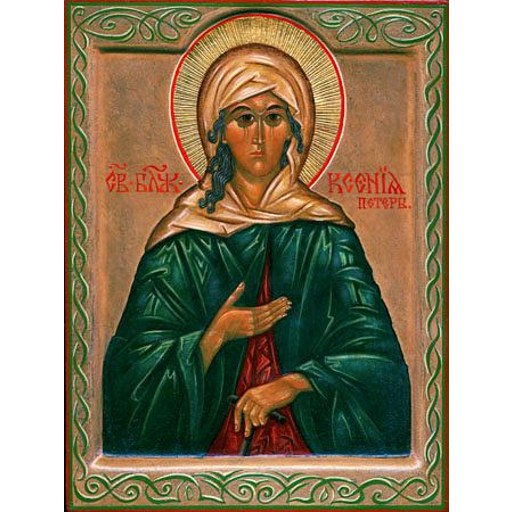
unknown Orthodox Christian painter
License: Public domain
Xenia of Saint Petersburg
Saint- Feast Day
- 24 January and 11 September
- Gender
- female
- Church
- Catholic
Places
Relics & Where to Venerate
Location unknown
The bodily remains of Xenia of Saint Petersburg are a first-class relic. Venerated at Smolenskoye Orthodox Cemetery.
Roles & Family
Religious Information
Patronage
Saint Petersburg;those seeking employment;those seeking marriage;families;the homeless
Canonization
Biography
Xenia of Saint Petersburg, known in the Russian Orthodox tradition as Blessed Xenia or Saint Xenia the Fool-for-Christ, was an eighteenth-century ascetic whose life is known almost entirely from later hagiographical accounts and popular memory rather than from contemporary archival documents. Tradition places her birth in Saint Petersburg in the early eighteenth century, into a family of some social standing; her baptismal name is given as Xenia Grigoryevna, while her maiden surname is not securely recorded. In youth she married Andrei Feodorovich Petrov, a colonel who served as a singer in the imperial court choir. The couple lived in the parish of Saint Matthias. When she was about twenty-six, her husband died suddenly, reportedly after a drinking bout and without having received the last rites of the Church. Grief over his unprepared death, according to the lives, became the turning point of her vocation.
After Andrei’s death she gave away her house, money, and possessions to the poor. She put on her late husband’s military uniform and insisted on being addressed only as Andrei Feodorovich, saying that Xenia had died and that Andrei lived. Relatives at first treated her as insane and sought to have her confined, but she was judged of sound mind. She then took up the life of a fool-for-Christ (yurodivaya), wandering the streets of Saint Petersburg, especially the poorer quarters near the Smolensk Cemetery and on the Petersburg Side. For some forty-five years she endured mockery, cold, and hunger, sleeping in fields or porches and spending nights in prayer. What began as apparent madness came to be recognized by many inhabitants as a form of holy folly. She was credited with clairvoyance and prophecy, including a foretelling of the death of Empress Elizabeth Petrovna in 1761, and with counsel about marriages, journeys, and misfortunes that later proved accurate.
One of the best-attested later episodes concerns the building of the stone church of the Smolensk Icon of the Mother of God at the Smolensk Cemetery. By night she secretly carried bricks up the scaffolding to help the workmen, a labor noticed only when the work advanced faster than expected. She accepted alms only from those she believed to be of good conscience and immediately gave away whatever she received. Merchants counted it fortunate if she entered their shops; cab drivers regarded a ride with her as a good omen. She died, according to tradition, at the beginning of the nineteenth century, around 1803, though the precise year is not established in contemporary records. She was buried in the Smolensk Cemetery, where a chapel was later raised over her grave. The site became a place of popular pilgrimage; earth from the grave and oil from the lampada were taken as blessings, and numerous healings and answered prayers were attributed to her intercession.
Veneration of Blessed Xenia was already widespread among the Orthodox faithful of Saint Petersburg in the nineteenth and early twentieth centuries, but formal glorification came only in the later twentieth century. The Russian Orthodox Church Outside Russia canonized her in 1978. The Moscow Patriarchate included her among the saints glorified in 1988, during the millennium of the Baptism of Rus’. Her principal feast days in the Orthodox calendar are 24 January and 11 September (Julian dating). She is invoked especially as a heavenly patron of Saint Petersburg and, in popular devotion, for help in family life, marriage, employment, and housing. The chapel at the Smolensk Cemetery remains a major pilgrimage destination.