Yolanda of Vianden is a blessed of the Catholic Church (1231 - 1283). Yolanda of Vianden's feast day is celebrated on 17 December.
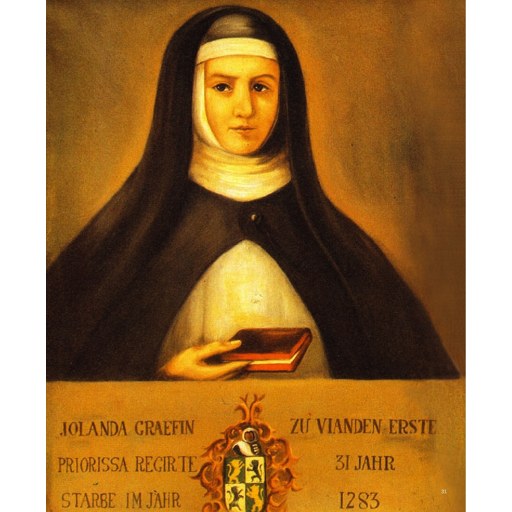
The original uploader was Florence Berg at Luxembourgish Wikipedia.
License: Public domain
Yolanda of Vianden
Blessed- Life Span
- 1231 - 1283 (age 52)
- Feast Day
- 17 December
- Gender
- female
- Church
- Catholic
Places
Roles & Family
Religious Information
Biography
Yolanda of Vianden was born in 1231 as a daughter of Count Henry I of Vianden and Margaret of Courtenay, Marchioness of Namur. The County of Vianden lay in the Ardennes within the Holy Roman Empire, in the region of present-day Luxembourg, and its castle on the Our was the family's principal seat. Through her mother, a daughter of Peter of Courtenay and of Yolanda of Flanders, she belonged to a lineage that had occupied the throne of the Latin Empire of Constantinople. The household was thus both a regional power in the Low Countries and connected to the wider crusading aristocracy of the thirteenth century. Among her siblings was Henry of Vianden, who entered the Dominican Order and later served as bishop of Chełmno in Prussia, a circumstance that helps explain the family's ties to the Order of Preachers.
The principal source for her early life is a lengthy Middle High German verse biography composed by Brother Hermann of Veldenz, a Dominican writing in the years after her death. According to that account, her parents intended her for marriage to a nobleman of Monschau, a match consistent with the dynastic strategies of a mid-thirteenth-century comital house. Yolanda instead formed a resolution to enter the recently founded Dominican convent of Marienthal (Mariendall) in the valley of the Eisch, west of the town of Luxembourg. The convent had been established in the 1230s and followed the Dominican observance for nuns. Tradition describes a sharp conflict with her mother: Yolanda took refuge with the sisters, was forcibly brought home, and only after a protracted struggle—during which ecclesiastical authorities and members of her own family, including her Dominican brother, played a part—received permission to remain. She entered Marienthal as a young woman, in the later 1240s according to the usual reconstruction of the chronology.
Thereafter she lived as a Dominican nun at Marienthal for the rest of her life. Later tradition and Hermann's poem present her as prioress of the community, an office she is said to have held for a substantial period until her death. Independent conventual archives from the thirteenth century are sparse, so the details of her governance, the size of the community, and her personal practices of prayer and asceticism rest largely on the poetic life and on subsequent local memory. The nuns of Marienthal observed enclosure and the Dominican liturgy. Yolanda died at the convent on 17 December 1283.
Memory of Yolanda was preserved above all by Brother Hermann's epic, which circulated in the Luxembourg region and framed her resistance to an arranged marriage as a triumph of religious vocation. She has been honoured locally as blessed, particularly in Luxembourg, and 17 December, the day of her death, has been observed as her feast. She was not the subject of a formal papal canonization of the later medieval or modern type, and claims of a universal cult should be treated with caution. Sites associated with her remain Vianden Castle and the former convent of Marienthal. Historians depend heavily on a single near-contemporary literary source; many particulars of her biography cannot be confirmed from charters or independent chronicles, yet the outline of a comital daughter who became a Dominican prioress in thirteenth-century Luxembourg is consistent across standard reference works.