Zechariah is a saint of the Catholic Church. Zechariah's feast day is celebrated on 5 September (Eastern Orthodox, Lutheran); 23 September (Roman Catholic).
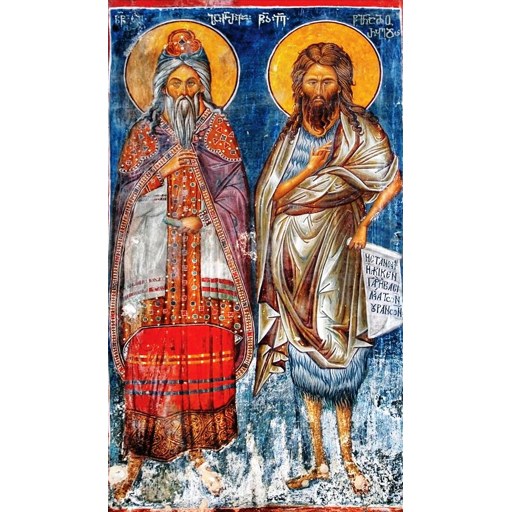
Unknown authorUnknown author
License: Public domain
Zechariah
Saint- Feast Day
- 5 September (Eastern Orthodox, Lutheran); 23 September (Roman Catholic)
- Gender
- male
- Church
- Catholic
Places
Roles & Family
Religious Information
Biography
Zechariah (also rendered Zacharias or Zachary; Hebrew Zekharyah, meaning YHWH has remembered) is known principally from the Gospel of Luke as a Jewish priest of the division of Abijah and as the father of John the Baptist. Luke presents him and his wife Elizabeth, who was of the daughters of Aaron, as righteous before God and blameless in observing the Lord's commandments, yet childless in their old age because Elizabeth was barren. Their residence is located in the hill country of Judea. As a member of one of the twenty-four priestly courses that served in rotation at the Jerusalem Temple, Zechariah was chosen by lot during his division's week of duty to enter the sanctuary and burn incense, an honour that for many priests occurred only once in a lifetime.
According to the first chapter of Luke, while Zechariah stood at the altar of incense, the angel Gabriel appeared to him at the right side of the altar and announced that Elizabeth would bear a son who was to be named John. The child would be great before the Lord, filled with the Holy Spirit even from his mother's womb, would turn many of the children of Israel to God, and would go before the Lord in the spirit and power of Elijah to prepare a people. Zechariah asked how this could be, since he was an old man and his wife advanced in years. Because of his unbelief, Gabriel declared that he would be silent and unable to speak until the day these things were accomplished. Elizabeth conceived and remained in seclusion for five months. In the sixth month she received a visit from her relative Mary. After the birth, on the eighth day at the circumcision, neighbours and kinsfolk intended to name the child Zechariah after his father, but Elizabeth said he should be called John. They made signs to the still mute father, who wrote on a writing tablet that his name is John. Immediately his mouth was opened and his tongue loosed; filled with the Holy Spirit he prophesied the canticle known as the Benedictus (Luke 1:68-79), which entered Christian liturgical use as a morning hymn of praise.
The canonical New Testament does not record Zechariah's subsequent life or the manner of his death. Extra-biblical Christian tradition, already present in the second-century Protoevangelium of James and developed by later Eastern authors, relates that he was murdered in the Temple at the time of Herod the Great's slaughter of the infants of Bethlehem, after he refused to reveal where his son John was hidden. Some later Christian writers associated this account with the saying of Jesus in Matthew 23:35 concerning the blood of Zechariah shed between the temple and the altar, although modern biblical scholarship more often refers that verse to the priest Zechariah son of Jehoiada in the Book of Chronicles, and the identification remains disputed. A rock-cut monument in the Kidron Valley east of Jerusalem, popularly known as the Tomb of Zechariah, has been linked in local tradition with this figure or with the prophet Zechariah; the structure is Hellenistic in style and the attribution is not historically demonstrated.
Zechariah is venerated as a saint in the Roman Catholic Church, the Eastern Orthodox Church, the Oriental Orthodox churches, and the Anglican Communion. The Eastern Orthodox and some Lutheran calendars keep his memory on 5 September, frequently together with Elizabeth; the Roman Catholic Church commemorates Saints Zechariah and Elizabeth on 23 September. In Islamic scripture a prophet named Zakariya, father of Yahya, appears in a related narrative of prayer for offspring in old age. Historically Zechariah belongs to the late Second Temple period in Judea under Herodian rule. No independent contemporary documentation of his life exists outside the Lucan infancy narrative and subsequent legend, and neither a year of birth nor a securely attested year of death is known.