Zeno of Verona is a saint of the Catholic Church (d. 371). Zeno of Verona's feast day is celebrated on 12 April. Zeno of Verona is the patron saint of Verona;fishermen;anglers;newborn babies.
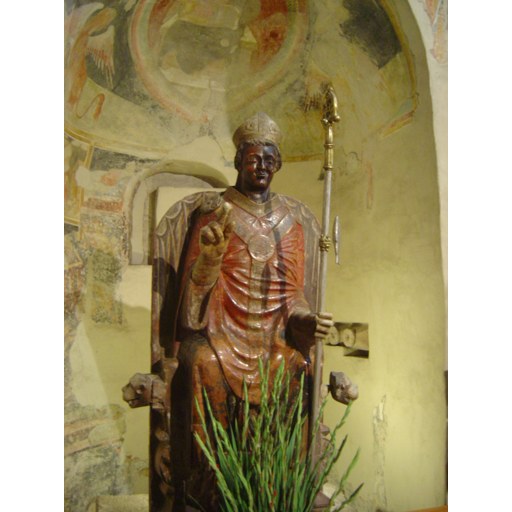
David Monniaux
License: CC BY-SA 3.0
Zeno of Verona
Saint- Life Span
- d. 371
- Feast Day
- 12 April
- Gender
- male
- Church
- Catholic
Places


Roles & Family
Patronage
Verona;fishermen;anglers;newborn babies
Biography
Zeno of Verona, known in Italian as San Zeno or San Zenone, was a fourth-century bishop of Verona in northern Italy and is venerated as a saint in the Catholic and Eastern Orthodox churches. Later medieval tradition, which cannot be confirmed from contemporary records, holds that he was born in the Roman province of Mauretania in North Africa. His Greek name was relatively common in the African provinces, and some features of the Latin of the sermons attributed to him have been compared with African Christian writers, but his origin remains a matter of inference rather than proof. Nothing reliable is known of his family, education, or the circumstances of his coming to Italy. Later hagiography describes him as having lived an ascetic or monastic life before he became bishop, yet those details belong to legend rather than to the fourth-century evidence.
He is counted as the eighth bishop of Verona in the traditional episcopal catalogues of the see. His episcopate is generally placed in the 360s, a period marked by the Arian controversy, the short-lived pagan restoration under the emperor Julian (361-363), and the still considerable strength of traditional Roman religion in the cities of the Po valley. In the sermons transmitted under his name he opposes Arian teaching on the Son and criticizes pagan rites and festivals. He presents Christian initiation, especially the rites of baptism at the Easter vigil, as the centre of pastoral life, and he instructs catechumens at length on the meaning of the font, the anointings, and the Eucharist. He also exhorts his hearers to almsgiving, chastity, and care for the poor. Verona in his lifetime was a community in which the church was establishing a public identity rather than a fully Christianized city, and his preaching reflects that missionary and catechetical situation.
The main historical witness to Zeno is a corpus of roughly ninety sermons or tractates preserved under his name. Written in a vigorous and sometimes ornate Latin, they treat the liturgical year, above all Easter and Pentecost, the praise of virginity and of the martyrs, and a range of moral and doctrinal subjects. They are among the most important sources for the baptismal liturgy of northern Italy in the fourth century and show points of contact with the later Ambrosian tradition of Milan, although Zeno's time as bishop largely preceded the episcopate of Ambrose. Scholars have debated the authenticity of every piece in the collection, but a substantial core is widely accepted as his. The sermons allude to church building and to the veneration of martyrs, suggesting an active programme of cult and construction, even if later claims that he built the first cathedral or numerous churches cannot be verified in detail.
According to the traditional date of his feast he died at Verona on 12 April; the year is commonly given as 371, though some historians have argued for a date near 380. He died in a time of peace for the Italian church and is therefore a confessor rather than a martyr in the strict sense, even though some early notices apply the title of martyr to him in a broader or honorific way. He was buried outside the walls of Verona; a church rose over his tomb and, after successive rebuildings, became the present Basilica of San Zeno Maggiore, a major monument of Italian Romanesque architecture. His relics are preserved in the crypt. By the early Middle Ages he was the principal patron of Verona; Pope Gregory the Great mentions him, and his name appears in martyrologies. His feast is kept on 12 April, and Verona also commemorates a translation of relics on 21 May. He is invoked as patron of the city and diocese of Verona, of fishermen and anglers (he is often shown with a fish or a fishing rod, and a well-known statue in Verona depicts him smiling), and of newborn children, and he has been called upon against floods of the river Adige. Medieval legend added miracle stories, including exorcisms and wonders involving water and fish, which illustrate his later cult rather than the historical bishop of the fourth century.