Zenobius is a saint of the Catholic Church (d. 417). Zenobius's feast day is celebrated on 25 May. Zenobius is the patron saint of Florence.
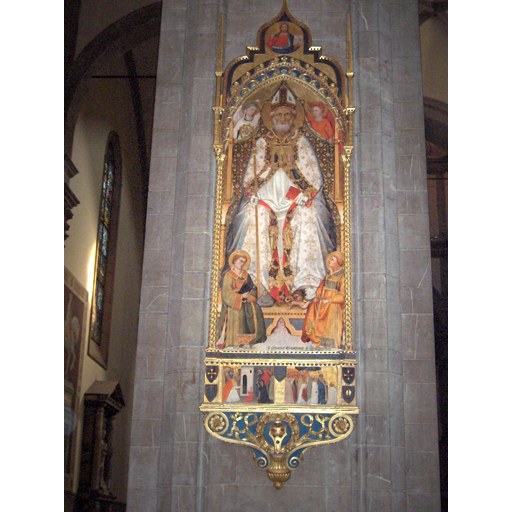
https://en.wikipedia.org/wiki/Zenobius_of_Florence
License: unknown
Zenobius
Saint- Life Span
- d. 417
- Feast Day
- 25 May
- Gender
- male
- Church
- Catholic
Places
Roles & Family
Patronage
Florence
Canonization
Biography
Saint Zenobius, known in Italian as San Zanobi or San Zenobio, was bishop of Florence in the later fourth and early fifth centuries and is venerated as a saint in the Catholic Church. Traditional Florentine accounts state that he was born in Florence to a noble family that still adhered to the pagan religion of the Roman civic elite. His parents are said to have resisted his attraction to Christianity, but he received baptism from Bishop Theodore of Florence and thereafter entered the service of the Church. Later legend adds that his father and mother were themselves converted through his example. No contemporary document records the year of his birth, and the figures sometimes printed in modern notices are inferences or later constructions rather than attested dates.
After baptism, according to the medieval vitae, Zenobius spent a period in Rome and lived in notable austerity before being ordained. Florentine tradition closely associates him with Saint Ambrose of Milan, who is said to have esteemed him and, in some versions of the story, to have consecrated him bishop of Florence. Zenobius is generally treated as the first bishop of that see whose name is known with reasonable security. His episcopate fell in a period when Nicene Christianity was consolidating its position in Italy against remaining pagan practice and against Arianizing currents. He is credited in later sources with preaching in Florence and in the Tuscan countryside and with organizing the local church.
The hagiographical tradition, which took written form many centuries after his death and is of limited value as narrative history, attributes to him a series of miracles. The best known is the restoration to life of a child, variously described as a boy crushed by a cart in the streets of Florence or as the son of a pilgrim from Gaul who had been left in the bishop’s care. Other wonders include healings and further resuscitations. A separate and very popular legend belongs to the later translation of his body: an elm standing in what is now the Piazza San Giovanni is said to have put forth leaves in winter when the saint’s coffin touched it. Zenobius is traditionally said to have died in Florence on 25 May in the year 417, although 429 appears in some later writers. He was first buried in the basilica of San Lorenzo, a church associated with relics that Ambrose is said to have sent to Florence. His remains were subsequently translated to Santa Reparata and, after the rebuilding of the cathedral, enshrined in Santa Maria del Fiore, where they remain.
Devotion to Zenobius became a central element of Florentine civic religion. His principal feast is 25 May; the archdiocese of Florence also keeps 26 January in memory of the translation of his relics. He is honored as a patron of the city of Florence, together with Saint John the Baptist. Because he lived long before the development of formal papal canonization, his cult belongs to the pre-congregation period and rests on continuous local veneration and liturgical observance rather than on a dated decree of a particular pope. From the fifteenth century onward his legend was a major subject of Florentine art. Sandro Botticelli, Domenico Ghirlandaio, Ridolfo Ghirlandaio, and other painters produced panels and frescoes of his miracles and of the flowering elm for the cathedral works and for churches of the city, and these images have done as much as the written vitae to fix his story in the memory of Florence.