Zosima of Solovki is a venerable of the Catholic Church (d. 1478). Zosima of Solovki's feast day is celebrated on 17 April, 8 August. Zosima of Solovki is the patron saint of beekeepers;Solovetsky Monastery.
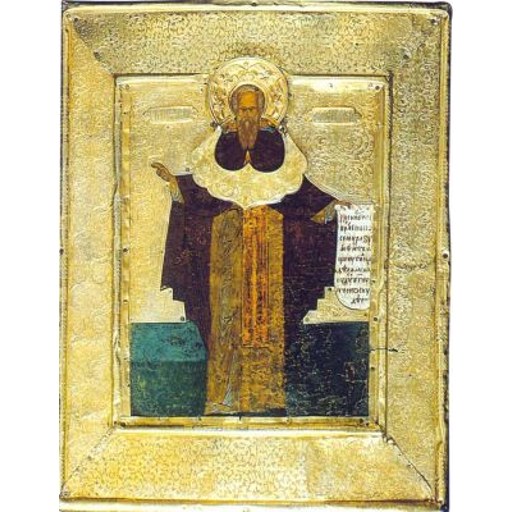
AnonymousUnknown author
License: Public domain
Zosima of Solovki
Venerable- Life Span
- d. 1478
- Feast Day
- 17 April, 8 August
- Gender
- male
- Church
- Catholic
Places
Roles & Family
Religious Information
Patronage
beekeepers;Solovetsky Monastery
Canonization
Biography
Zosima of Solovki (also called Zosimas) was a fifteenth-century Russian Orthodox monk and the principal organiser of the Solovetsky Monastery, which became one of the foremost monastic houses of the Russian North. According to his hagiographical Life, compiled in the late fifteenth and early sixteenth centuries by the Solovki monk Dositheus from the testimony of Zosima’s companion Herman and from monastic tradition, he was born in the village of Shunga in the Obonezhye district of the Novgorod lands, on the shore of Lake Onega. The vita names his parents Gabriel and Barbara and describes them as pious people of peasant standing. From youth he is said to have been drawn to prayer and renunciation. He left home and received the monastic tonsure at the Paleostrov Monastery on Lake Onega, a house already known for eremitical and communal life in the Novgorod north.
Seeking a stricter solitude, Zosima learned of the uninhabited Solovetsky Islands in the White Sea, where the monk Savvaty (Sabbatius), formerly of the Kirillo-Belozersky Monastery, had lived as a hermit with Herman of Solovki. Savvaty died in 1435 on the mainland, at a chapel on the Vyg River, before Zosima reached the islands. In the following year, traditionally given as 1436, Zosima sailed to Solovki with Herman, who knew the islands and their fishing grounds. There they established a hermitage that grew into a coenobitic monastery. Zosima became its first hegumen. Under his leadership the brethren built wooden churches, including churches of the Transfiguration and of the Dormition, organised a communal rule, and obtained from the Archbishop of Novgorod and from Novgorod civic authorities charters confirming the monastery’s hold on the Solovetsky Islands and on neighbouring fishing and salt-working rights.
The house’s rise brought both patronage and strain. Novgorod archbishops sent antimensia, books, and vestments, and Novgorod boyars and merchants made gifts. Later tradition linked the monastery with Marfa Boretskaya, the Novgorod posadnitsa, though that relationship is coloured by legend. The vita portrays Zosima as an organiser of labour as well as of prayer: the monks fished, boiled salt, and cleared land in a harsh northern climate. Internal discord or external pressure is said to have forced him off the islands for a time; he went to Novgorod, secured the archbishop’s support, and returned to the abbacy, which he held until his death.
Zosima died at the monastery on 17 April 1478 and was buried on Solovki. Local veneration began soon afterwards. His relics, together with those of Savvaty, were uncovered and translated on 8 August 1566 into the stone Cathedral of the Transfiguration. All-Russian canonisation followed the Moscow councils held under Metropolitan Macarius in 1547, which established a common feast for the Solovki founders. The Russian Orthodox Church commemorates Zosima on 17 April (the day of his repose) and on 8 August (the translation of the relics); he is also remembered in the Synaxis of the Saints of Solovki. Together with Savvaty he became heavenly patron of the Solovetsky Monastery and, in Russian popular devotion, of beekeepers. The monastery he organised later grew into a major fortress-monastery of Muscovite and imperial Russia, and the cult of Zosima and Savvaty spread through icons, liturgical services, and pilgrimage to the White Sea islands.