Zosima Verkhovsky is a venerable of the Catholic Church (1768 - 1833). Zosima Verkhovsky's feast day is celebrated on 24 October.
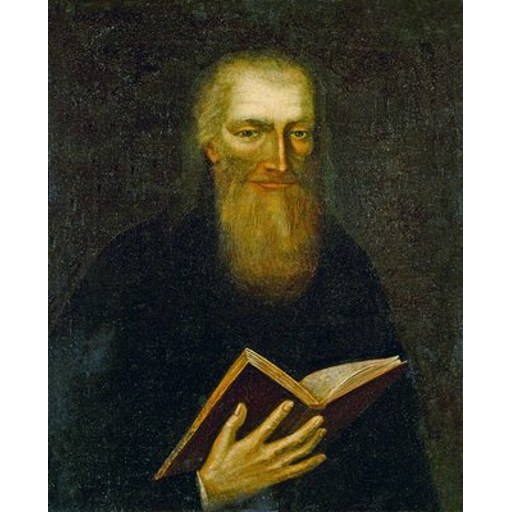
AnonymousUnknown author
License: Public domain
Zosima Verkhovsky
Venerable- Life Span
- 1768 - 1833 (age 65)
- Feast Day
- 24 October
- Gender
- male
- Church
- Catholic
Places
Relics & Where to Venerate
Location unknown
The bodily remains of Zosima Verkhovsky are a first-class relic. Venerated at Vvedenskoye Cemetery.
Roles & Family
Canonization
Biography
Zosima Verkhovsky, known in the world as Zakhar (Zachariah) Vasilyevich Verkhovsky, was a Russian Orthodox schema-monk and hermit of the late eighteenth and early nineteenth centuries, later venerated as a saint of the Russian Orthodox Church. He was born on 24 March 1768 into a family of modest provincial nobility; his father was Vasily Ivanovich Verkhovsky. Traditional Orthodox accounts of his life place his birth in the village of Buzhaninovo in the Dmitrov district of the Moscow Governorate. He received a home education typical of the lesser gentry and, as a young man, entered military service in the Preobrazhensky Life Guards Regiment. After several years in the army he left the service toward the end of the 1780s in order to pursue a monastic life, together with his brother Ivan, who was later tonsured with the name Moses. There is no record of marriage or children; his adult life from that point was that of a celibate monk.
Drawn to the hesychast revival associated with Saint Paisius Velichkovsky, Verkhovsky spent a period among the hermits of the Roslavl forests in the Smolensk region, where disciples of Paisius lived in sketes. In the early 1790s he traveled to Siberia. He was received at the Turukhansk Trinity Monastery on the Yenisei and was tonsured a monk with the name Zosima. For roughly two decades he lived as a hermit in the Siberian taiga, occupying remote cells on tributaries of the Yenisei, including the Bakhta and Dubches rivers. In that wilderness he practiced the Jesus Prayer and the ascetic discipline of the desert fathers, and he gradually attracted a small circle of disciples. Later Orthodox sources present this long Siberian sojourn as the formative period of his spiritual life and as the reason he is sometimes remembered among the saints connected with Siberia as well as with Moscow.
In the early 1820s Zosima returned from Siberia to European Russia. With the support of pious laywomen and with hierarchical blessing he established a women’s monastic community southwest of Moscow, which became the Trinity-Odigitrievskaya Zosima Hermitage (Troitsko-Odigitrievskaya Zosimova pustyn), dedicated to the Holy Trinity and to the icon of the Mother of God Hodegetria. He served as spiritual father to the sisterhood, giving instruction in inner prayer and monastic order while remaining a schema-monk rather than a diocesan bishop or ruling prelate. His teaching, preserved in letters and in the memories of his spiritual children, emphasized humility, unceasing prayer, and obedience, in continuity with the Paisian school of Russian hesychasm. He was never a pope or a patriarch, and he held no episcopal see.
Zosima died on 24 October 1833 at the hermitage he had founded and was buried there. Local veneration at his grave continued in the nineteenth century. After the restoration of church life in the late twentieth century, the Trinity-Odigitrievskaya Zosima Hermitage was reopened and his relics were uncovered and enshrined. He was glorified as a locally venerated saint of the Moscow diocese in 1999; his principal commemoration on 24 October in the Julian calendar (6 November Gregorian) was received more widely in the Russian Orthodox calendar, and he is also remembered among the saints of Moscow. Historical documentation of his life depends chiefly on monastic hagiography, correspondence, and diocesan tradition rather than on a large body of independent civil archives, so some details of his early geography and exact movements remain those of the received Orthodox vita.